10.08.26 By ForestFoodsSHIMBA HILLS: TEN HECTARES OF SPICE FOREST, AND A SCHOOL BESIDE IT
ForestFoods’ next farm: ten coastal hectares at Mwapala growing cacao, vanilla and spices among high-value timber — with farmer training designed in from the start.
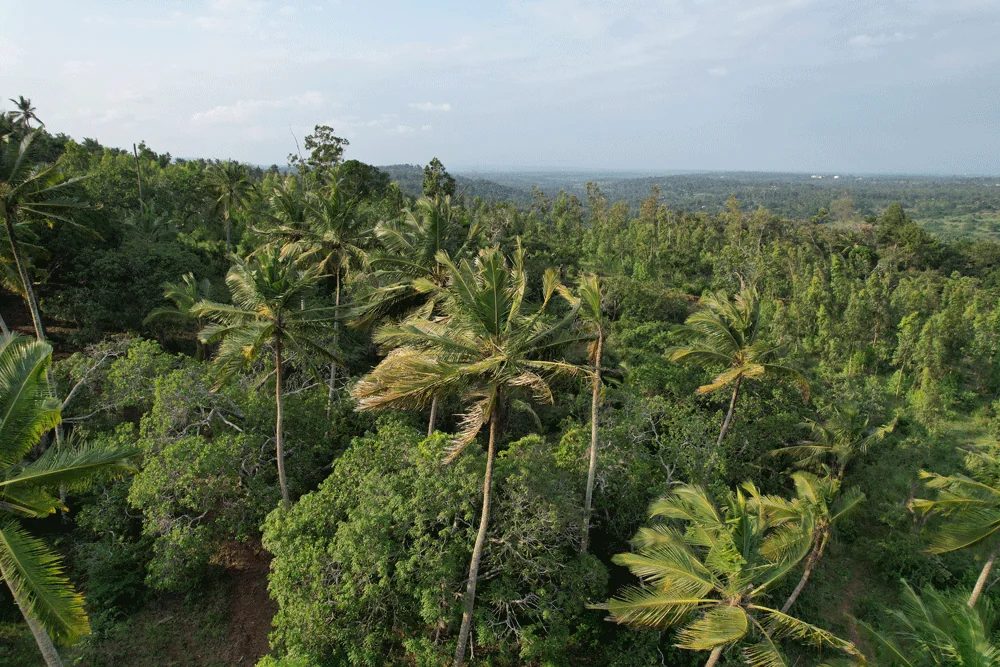
In mid-2023, ForestFoods secured a ten-hectare greenfield site at Mwapala, in the Shimba Hills of Kwale County. Ridge-to-flat terrain at 200 metres above sea level, native grasses and shrubs, stands of indigenous trees, an old eucalyptus plantation: to most buyers, raw land. To a syntropic farmer, a head start — succession already under way, waiting to be organised toward food.
Shimba Hills is set to become our flagship tropical production farm and one of East Africa’s most diverse commercial syntropic agroforestry systems. The site is being established around crops that thrive in layered tropical systems: cacao, vanilla, black pepper, cinnamon and cardamom, alongside tropical fruits and nuts, planted among high-value timber. The trees are not shade for the crops; the crops are not filler between trees. Each layer feeds the system that carries the others, the way Kenya’s coastal rainforest arranges itself without anyone’s help.
These are long crops, and that is the point. A vanilla vine or a cinnamon tree is a commitment measured in years, and it anchors a farm economy that keeps improving the land while it matures. As first harvests come in, Shimba Hills spices will join the ForestFoods Collection — traceable, like everything we grow, to a single hillside.
But Mwapala is designed to grow more than crops. Like Limuru, it will double as a centre for research, education and demonstration: a nucleus farm where local farmers train in the ForestFoods model and join the outgrower network that already includes Interplant in Naivasha and Nyani at Naro Moru — partners running regenerative plots on their own land with our agronomy support and a route to market.
That is what “scaling regeneration” means in practice. One nucleus farm, teaching; a network of outgrower farms, growing; a landscape shifting from depleted to productive, hillside by hillside. It is the same modular logic that took Limuru from a football pitch to a producing food forest — applied now at landscape scale, in a completely different agro-ecological zone, with the region’s farmers as partners rather than spectators.
The Shimba Hills project is early, deliberately so. Follow its progress here as planting advances, the training programme takes shape and the first spice harvests come down the ridge.