20.08.26 By ForestFoodsFROM PITCH TO PRODUCE: HOW THE LIMURU FARM CAME ALIVE
How ForestFoods turned a compacted football pitch at Brackenhurst, Limuru into a 2.19-hectare flagship syntropic agroforestry farm — with the soil data to prove it.
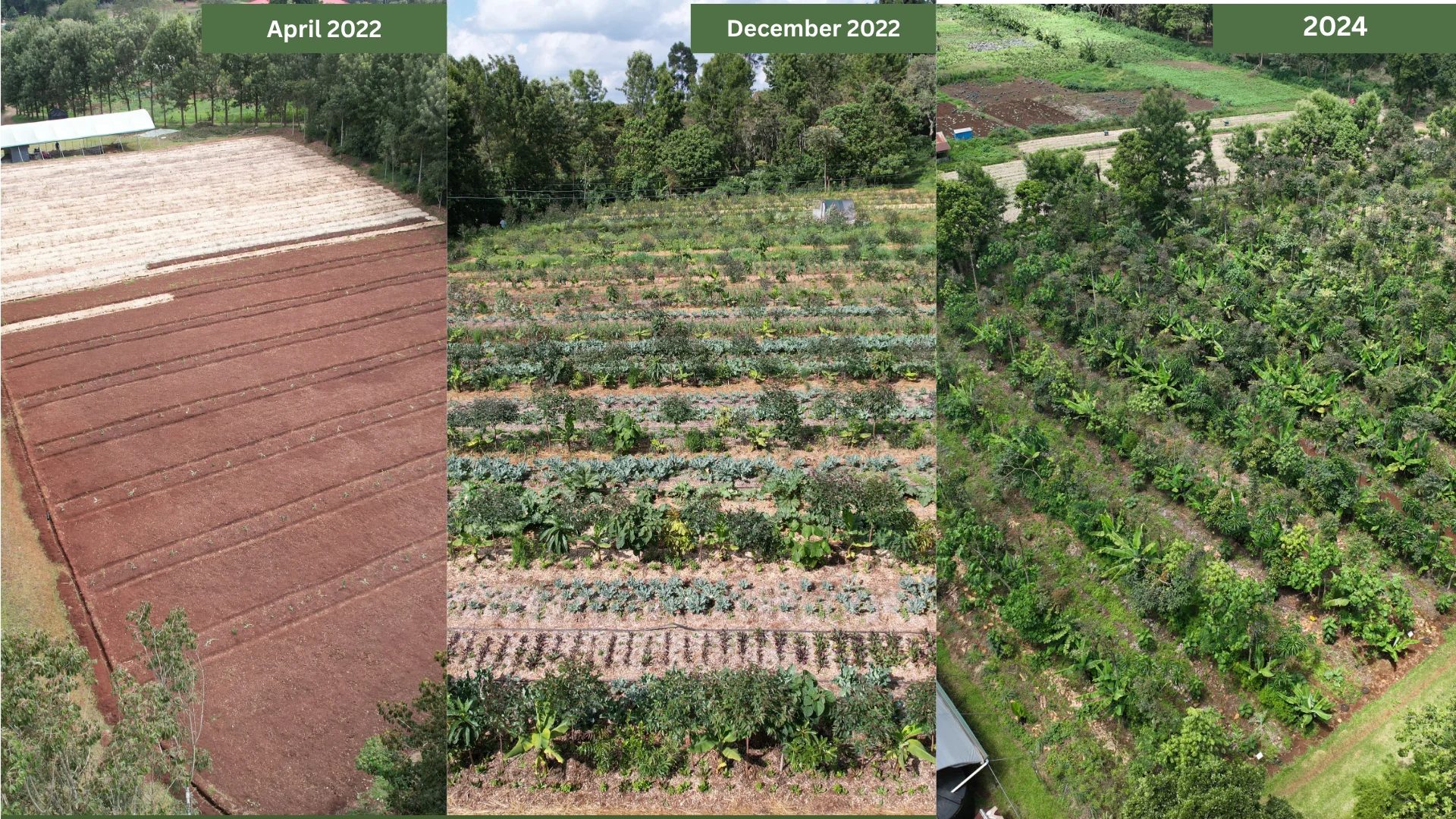
In April 2022, the ground that is now ForestFoods’ flagship farm was a football pitch at Brackenhurst, Limuru — compacted, bare and biologically silent. No topsoil worth the name, no insect hum, nothing to suggest food. It was, in the best possible way, a perfect test: if syntropic agroforestry could work here, it could work almost anywhere in Kenya.
Syntropic agroforestry farms the way forests grow. Instead of clearing land for one crop, we planted many species at once, organised in layers — pioneer trees to break the ground and cast first shade, fruit and vegetable strata beneath them, ground covers holding moisture at the floor. Everything pruned hard and often, with every cut branch returned to the soil as mulch. The forest feeds itself; so does a syntropic farm.
The method had already proved itself once. In May 2019, on a quarter-hectare experimental plot called Tamalu at Maritati on Mount Kenya, we learned that highly diverse syntropic agroforestry could produce exceptional yields on Kenyan land. Limuru was the same idea at flagship scale — and the change came faster than scepticism could keep up. Microbial activity in the soil rose. Water retention improved — beds that once shed rain began holding it. Biodiversity returned at every height, from insects in the mulch to birds in the young canopy. The pitch became an ecosystem, and the ecosystem began producing food.
Today the farm covers 2.19 hectares at 2,240 metres in Kenya’s cool highlands. Its orchard rows are coming into their own — raspberries, blackberries, strawberries, pears and plums — while the Upanuzi fields (from the Swahili for “expansion”) send broccoli, cauliflower, sweet potatoes, French beans, carrots, pak choi and courgettes to the packhouse. Harvests reach Nairobi homes and restaurants the same day they are picked, through our weekly veg boxes and our retail partner Greenspoon’s shelves.
The Limuru farm is also where we let the method speak for itself. Soil biology is tested independently at the ICRAF Laboratory, including counts of the mycorrhizal fungi that signal genuinely living ground. Visitors walk the rows on guided tours; students take our Fundamentals of Regenerative Agriculture courses and Syntropic Agroforestry Masterclasses metres from the beds that prove the theory; the Muna Tree Café up the path cooks what the farm grew that morning.
We tell the pitch-to-produce story often, because it answers the question we hear most: does regenerative farming actually work, here, on tired East African land, at commercial quality? The Limuru farm’s answer is measured in soil data, weekly harvest crates and a canopy where a goal mouth used to be.
Come and see it. Tours run on the first and last Friday of every month, with 48 hours’ notice — and the farm makes its own argument better than we can.